RABIES: Rodent Automated Bold Improvement of EPI Sequences.
RABIES is an open source image processing pipeline for rodent fMRI. It conducts state-of-the-art preprocessing and confound correction, and supplies standard resting-state functional connectivity analyses. Visit our documentation at https://rabies.readthedocs.io/en/latest/.
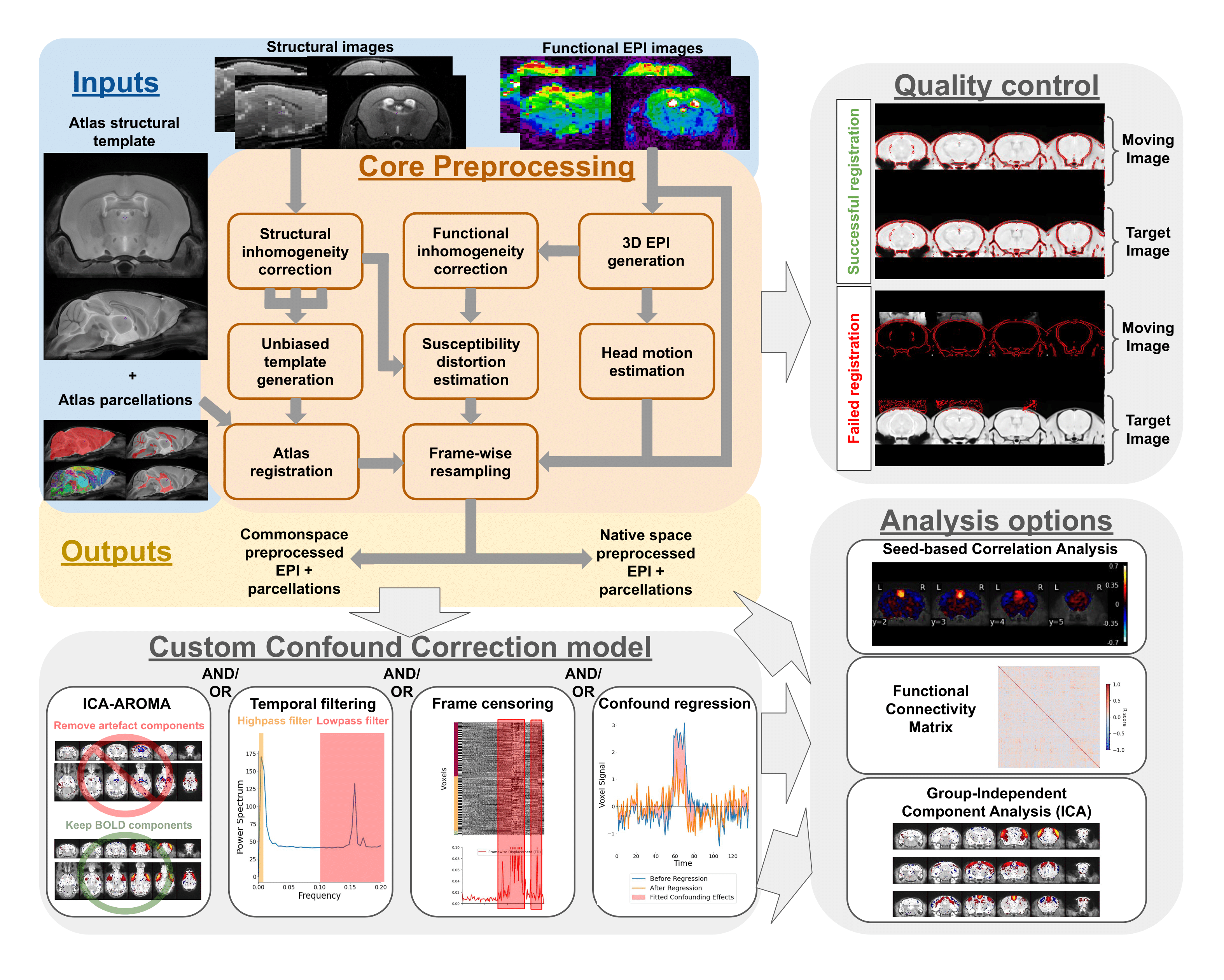
What you can do with RABIES
The primary purpose of RABIES is to provide rodent fMRI research with a standard, flexible, and reliable image processing platform. The package is complemented with informative data diagnostic features for confound characterization and encourages best practices for quality control and reproducibility. The RABIES software is structured into three main processing stages: preprocessing, confound correction and analysis.
Preprocessing
The preprocessing workflow regroups essential fMRI preprocessing steps prior to analysis. It includes a robust registration workflow with automatically-adapting parameters allowing to succesfully process diverse acquisition types (i.e. rodent species, scan field strength, coil type, …), and can conduct the following preprocessing steps:
head motion correction
susceptibility distortion correction
resampling to native or common space
slice timing correction (optional)
despiking (optional)
visual assessment of registration for quality control
Confound correction
Following preprocessing, RABIES provides a highly-customizable confound correction pipeline regrouping several common strategies:
frame censoring (or scrubbing)
confound regression (with several options for nuisance regressors)
frequency filtering (highpass, lowpass, bandpass)
ICA-AROMA
spatial smoothing
Analysis
Simple resting-state connectivity analyses are made available after preprocessing and confound correction:
seed-based functional connectivity
whole-brain connectivity matrix
group-ICA
dual regression
Importantly, the analysis stage is also complemented by a data quality assessment report (executed with --data_diagnosis), which generates several indices of data quality and potential confounds, with the aim of improving preprocessing strategies, data interpretation and scientific transparency.
Notes on software design
Nipype workflows: The image processing pipelines are structured using the Nipype library, which allows to build dynamic workflows in the form of a computational graph. Each node in the graph consists of a processing step, and the required inputs/outputs define the links between nodes. In addition to supporting code organization, Nipype workflows also handle several plugin architectures for parallel execution as well as memory management. The computational time to run the entire RABIES pipeline will vary substantially depending on data size, but for most uses, it will range from a few hours to a day when using proper computational resources and parallel execution.
Reproducible and transparent research: RABIES aims to follow best practices for reproducible and transparent research, including the following:
open source code https://github.com/CoBrALab/RABIES
standardized input data format with BIDS
easily shared, automatically-generated visual outputs for quality control
containerized distribution of the software through Docker/Apptainer, and conveniently installed from our Github or Docker Hub servers.
Citation
Citing RABIES: Please cite the official publication Desrosiers-Grégoire, et al. Nat Commun 15, 6708 (2024). when referencing the software.
Boilerplate: a boilerplate summarizing the preprocessing and confound correction operations is automatically generated in the output folder. You can use the boilerplate to help describe your methods in a paper.
License
The RABIES license allows for uses in academic and educational environments only. Commercial use requires a commercial license from CoBrALab contact@cobralab.ca, http://cobralab.ca
Acknowledgements
This software was developed by the CoBrALab, located at the Cerebral Imaging Center of the Douglas Mental Health University Institute, Montreal, Canada, in affiliation with McGill University, Montreal, Canada. This work was supported by funding from Healthy Brains, Healthy Lives (HBHL), the Fonds de recherche du Québec - Santé (FRQS) and - Nature et technologies (FRQNT), and the Natural Sciences and Engineering Research Council (NSERC) of Canada. fMRIPrep was an important inspirational source for this project, in particular with regards to best practices for software reproducibility and code design using Nipype. We also thank the organizers of BrainHack School Montreal, which guided the initial steps of this project in 2018.
Ask for help
If you need support in using the software or experience issues that are not documented, we’ll provide support on the Github discussion.
Finding your way around this documentation
This documentation is organised around what you are trying to do right now.
Start here if RABIES is new to you. A guided run of the complete pipeline on a small example dataset, from raw BIDS input to a connectivity map.
Practical recipes for a specific goal. Installing RABIES, running it in a container, tuning a failed registration, designing a confound correction strategy, contributing code.
Look something up. Command line options, input requirements, every output file, and the precise definition of every metric.
Understand how RABIES works and why. The preprocessing and confound correction workflows, the analyses, and the data quality framework.